research before the build
2016→EKA's earlier web-analysis plan covered interviews, surveys, usability testing, analytics, SEO, and conversion before HAAM joined.


Estonian Academy of Arts / Higher education / 2017-Present
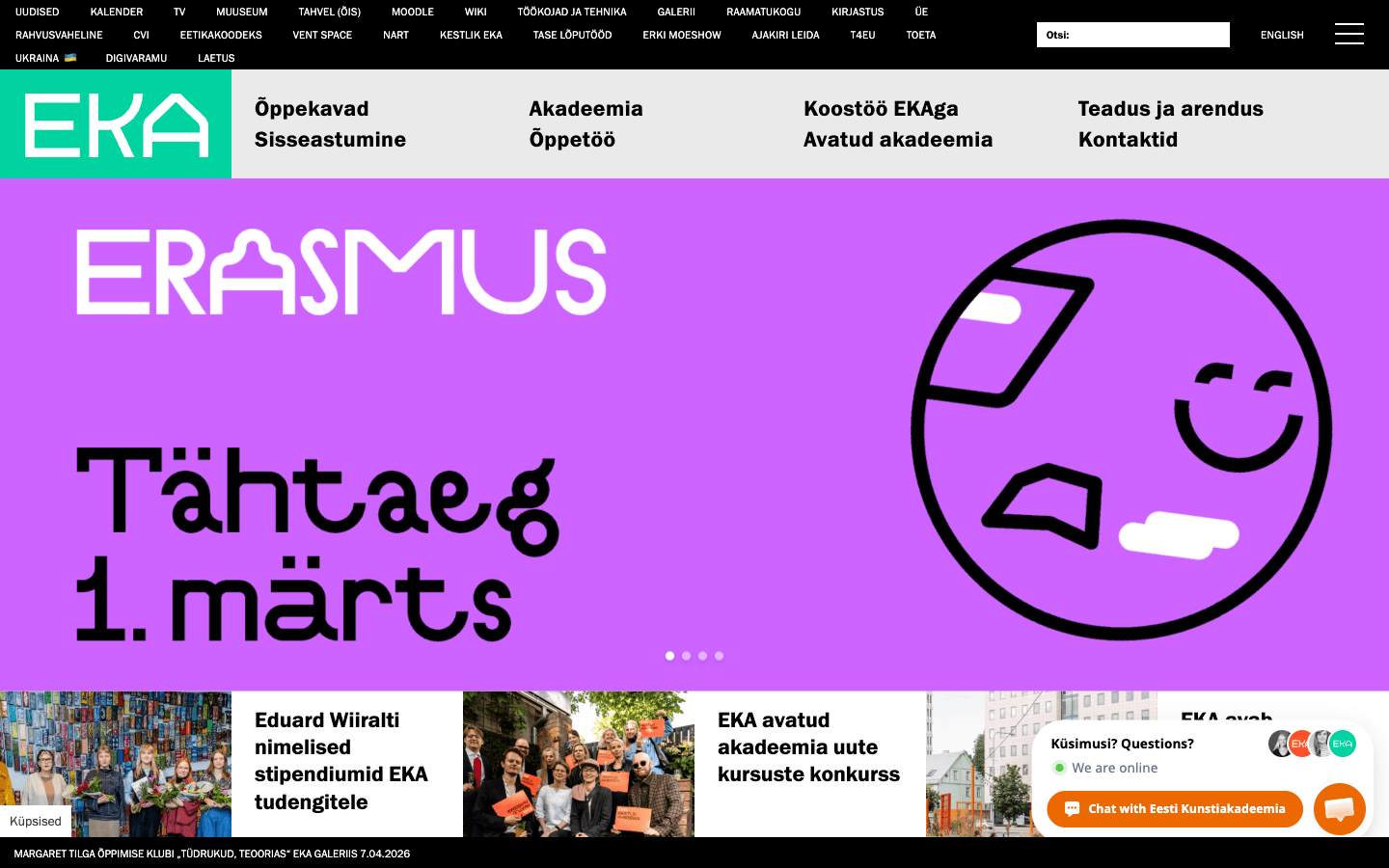
EKA's web project did not begin with HAAM, or with the CVI. By the time Solveig Jahnke contacted me in May 2017, the academy already had earlier research, analytics, wireframes, and a proposed redesign for its existing WordPress site. I joined to interrogate that work, turn it into a functioning product, resolve the parts the drawings could not anticipate, and help test and hand it over. A later redesign brought a new visual identity and CVI into the same living platform. In 2026 EKA hired HAAM for another year to upgrade the server, accessibility, performance, and cybersecurity.
research before the build
2016→EKA's earlier web-analysis plan covered interviews, surveys, usability testing, analytics, SEO, and conversion before HAAM joined.
HAAM joins
2017I inherited an existing WordPress site, research, wireframes, and proposed designs, then took the redesign into implementation and testing.
a later system layer
CVI + redesignThe new visual identity arrived with another redesign and had to become responsive, reusable behaviour rather than a static graphic handoff.
technical stewardship
2026→The current mandate covers server upgrades, accessibility, performance, cybersecurity, and continued platform health.
The real starting point
When Solveig sent me the background material in May 2017, one document was an existing EKA web-analysis plan with a stated deadline of 1 May 2016. It identified slow information finding for students and staff, dissatisfied departments, weak conversion optimization, and missed SEO opportunities. The proposed research included interviews with staff, students, and prospective students, questionnaires for three audiences, usability tests with five prospective students, exit surveys, and Google Analytics analysis of traffic, drop-off, bounce, devices, and browser problems.
The plan was already aimed at turning evidence into new design views, testing those views with users, and increasing international applications. When Solveig first approached HAAM on 24 May 2017, wireframes by Jaan Sonberg and a possible design solution already existed. My starting point was therefore not a blank canvas. It was a partly researched, partly designed, legacy product that still had to survive contact with real content, real editors, and the rest of the institution.
The project lifecycle
Earlier research, analytics, Jaan Sonberg's wireframes, a conversion-focused redesign, and the existing WordPress platform formed the starting conditions.
Implementation exposed missing states, new content types, navigation questions, mobile behaviour, search, galleries, and editorial workflows that static views could not fully resolve.
Testing, Trello handover, a later CVI-driven redesign, years of editorial change, and now technical renewal all became part of one continuing platform.
2026 modernization
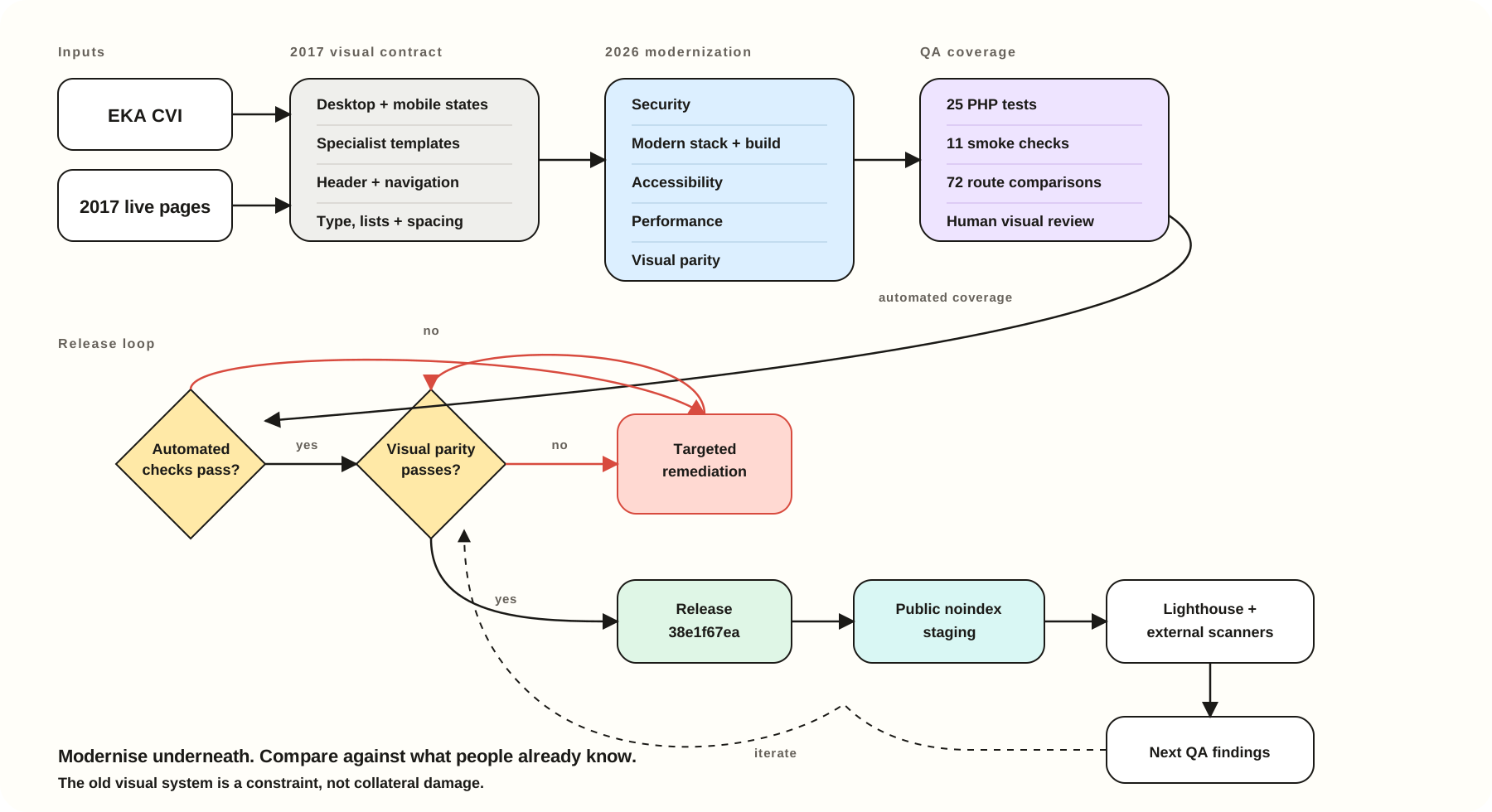
The 2026 job is deliberately not a redesign. I treated the 2017 live pages and EKA CVI as a visual contract, then changed the stack underneath: security, build tooling, accessibility and performance. Every change has to pass both automated checks and human visual comparison before it can move forward.
After launch
The evidence after launch is less glamorous and more valuable than a launch screenshot. The EKA2017 board continued accumulating questions about menus, categories, galleries, admissions pages, multilingual behaviour, publishing, calendars, media, and editor workflows across multiple years. By 2018 EKA was also preparing internal website-use guidance. The system was being used by the institution, not preserved as a pristine portfolio object.
That long life changes what good design means. Consistency is partly visual, but it is also whether editors can understand the rules, whether old decisions can be revisited without breaking everything else, and whether the technology underneath remains safe and usable. The new 2026 work continues the same idea at a deeper layer: make a proven public platform faster, more accessible, more secure, and easier to keep healthy.
HAAM’s role
HAAM's role began with reviewing existing research, analytics, Jaan Sonberg's wireframes, and proposed designs, then expanded into interaction design, information architecture, implementation, responsive behaviour, search and content-system decisions, testing, Trello-based handover, ongoing development, and long-term technical stewardship. The pre-HAAM visual proposal was produced by a Latvian designer recommended by an Estonian conversion specialist. A later visual-identity and CVI redesign was developed by Stuudio Stuudio and collaborators and integrated into the live platform with HAAM. The current mandate adds server upgrades, accessibility, performance, and cybersecurity.
Next case study
How we learned
Research looked across admissions, degree levels, programmes, departments, study services, research, events, languages, and the people maintaining all of it. The useful structure emerged by comparing visitor tasks with institutional ownership rather than choosing one side.
Evidence trail
Good interaction design should be traceable upstream. Depending on the project, that upstream work might be interviews, co-design, fieldwork, archive work, testing, analytics, or operations. Here is the shortest version of the chain from evidence to decision.
01
Admissions, degree levels, programmes, departments, study services, research, events, languages, and public audiences competed inside one institution.
02
Visitor tasks cut across the academy's internal org chart, so organisational ownership is context rather than primary navigation.
03
Prioritise intent, use structured programme records, and connect recurring content back to responsible units.
04
Institutional complexity becomes easier to navigate while departments retain a maintainable publishing structure.
Optional analytics. Google Analytics and Clarity load only if allowed; form, email, and chat content are excluded.